Note** I always try to be a transparent and as authentic as I possibly can. While visiting Budapest, I had the luxury of having a friend, show me around and share stories about his beloved city. With that said, there were some edits in this article that needed to be corrected. I’m blessed to have friends that want to make sure I get it right!**
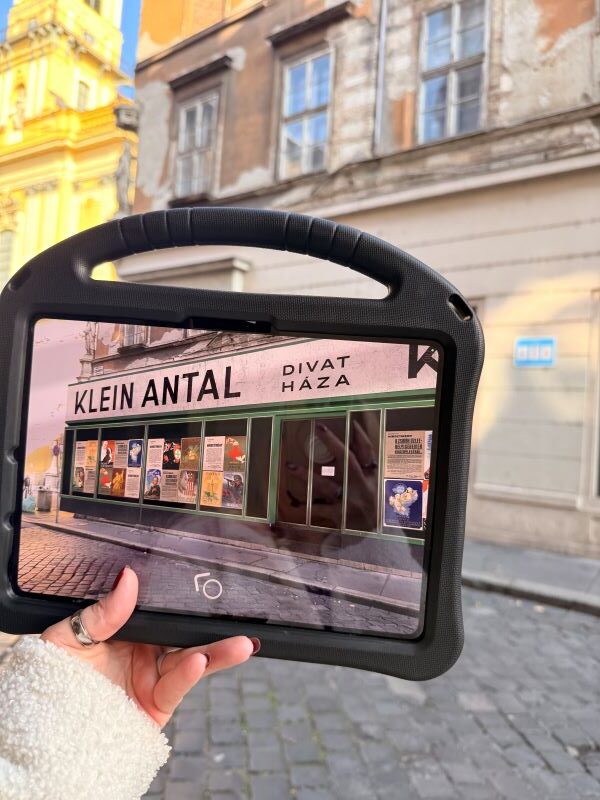
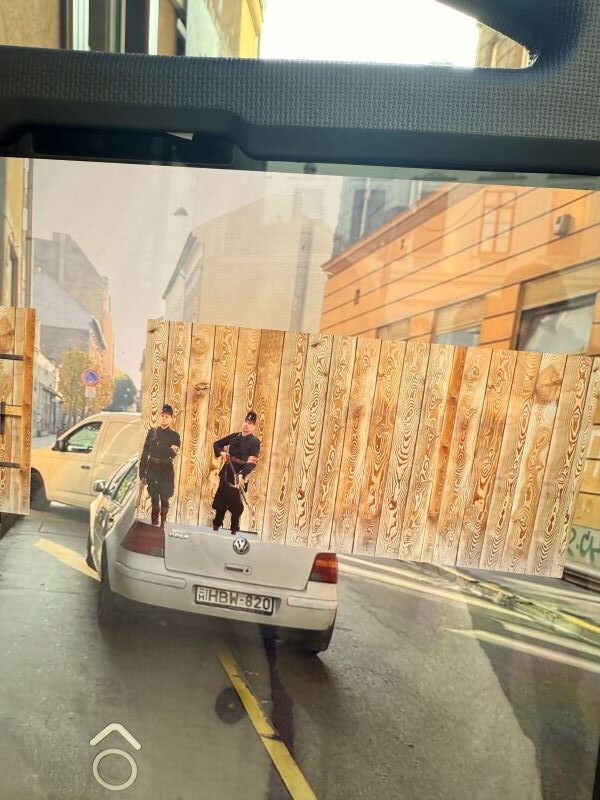
There are certain places in the world that move you in ways you don’t expect. For me, that moment happened in Budapest’s Jewish Quarter. As I wandered through District VII, where cafés and street art now fill once-devastated streets, I was suddenly standing where the ghetto walls once confined tens of thousands of people. With an AR (augmented reality) experience, layered over the scene, I could see the fences rise before my eyes and the Arrow Cross soldiers appear, ghosts of a dark past merging with the vibrant present. It was more than history; it was empathy…. It was “If These Streets Could Talk“.
I’ve visited many historical sites, but this one reached deeper. The Jewish Quarter of Budapest is alive with contradiction, where tragedy and resilience coexist, and where a community continues to thrive despite its painful past. It’s a neighborhood that invites reflection and understanding, not just sightseeing.
The Heart of Jewish Life in Budapest (Locals pronounce it Bud-a-pesh)
The Jewish Quarter, located in Erzsébetváros (District VII), was once the beating heart of Jewish life in Hungary. In the late 18th and early 19th centuries, restrictions on Jewish settlement slowly lifted, and the area became home to merchants, doctors, and lawyers who helped shape Budapest’s growing middle class. Between 1867 and World War I, this district flourished, a golden era when the Jewish community was central to the city’s cultural and economic life. Arguably, even up until World War II, or until 1938, to be more precise. (In fact, Jewish Budapest – and the Jewish Quarter – had its peak in the 1920s-30s)
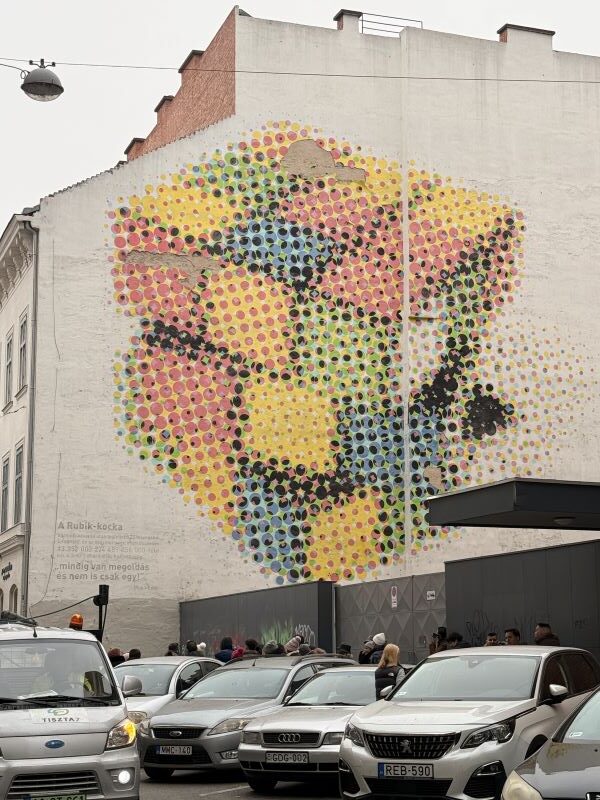
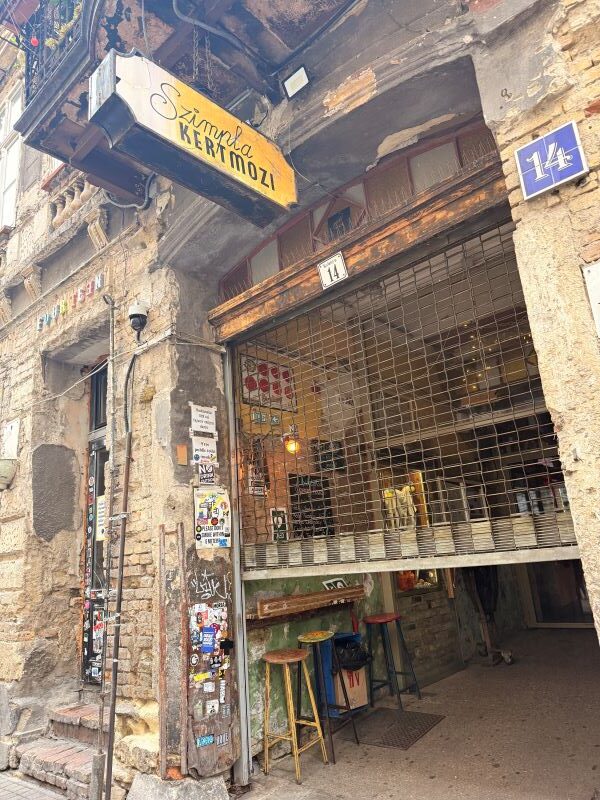
That vibrancy is still visible today, even in the smallest details. You can feel it in the ornate balconies of century-old buildings and in the smell of fresh pastries from local bakeries like Fröhlich, a kosher confectionery that has been serving the community for generations. It’s also alive in the conversations spilling out of cafés, the buzz of the famous ruin bars, and the street art that reclaims walls once marked by hate.
The Dohány Street Synagogue — A Monument of Faith and Survival
No visit to Budapest’s Jewish Quarter is complete without standing before the Dohány Street Synagogue. Often called the Great Synagogue, it’s not only the largest in Europe but also the second largest in the world. Designed by Ludwig Förster, the same architect who built the main synagogue in Vienna, it is a masterpiece of Moorish Revival architecture.
Walking through its gates you’ll feel a sense of awe. The twin towers rise elegantly, while the interior glows with gold and crimson details. Though it stands as a place of worship, it also carries the weight of remembrance. Within its courtyard is a memorial garden where the Tree of Life, a metal weeping willow, bears the engraved names of Hungarian Jews who perished during the Holocaust. Nearby lies a small cemetery, unusual for a synagogue, where victims of the ghetto are buried. Though I did not go inside and had only seen it in photographs, standing before the great building left me profoundly awestruck.
Today, the synagogue is still used by the local Jewish community, primarily members of the Neolog branch of Judaism, a uniquely Hungarian movement that pioneered a progressive, modern path, emphasizing integration into civic life while maintaining Jewish tradition. It’s open to the public Monday through Friday, and guided tours offer deeper insight into both the architecture and the resilience it represents. One cool fact is that the synagogue contains a magnificent organ, something typically associated with Catholic churches rather than synagogues.
The Shadows of the Ghetto
As beautiful as the quarter is, its past remains tangible. During World War II, this area became the Budapest Ghetto, established by the Nazis in late 1944. More than 70,000 Jews were forced into its cramped boundaries under the orders of the Arrow Cross Party, Hungary’s fascist collaborators.
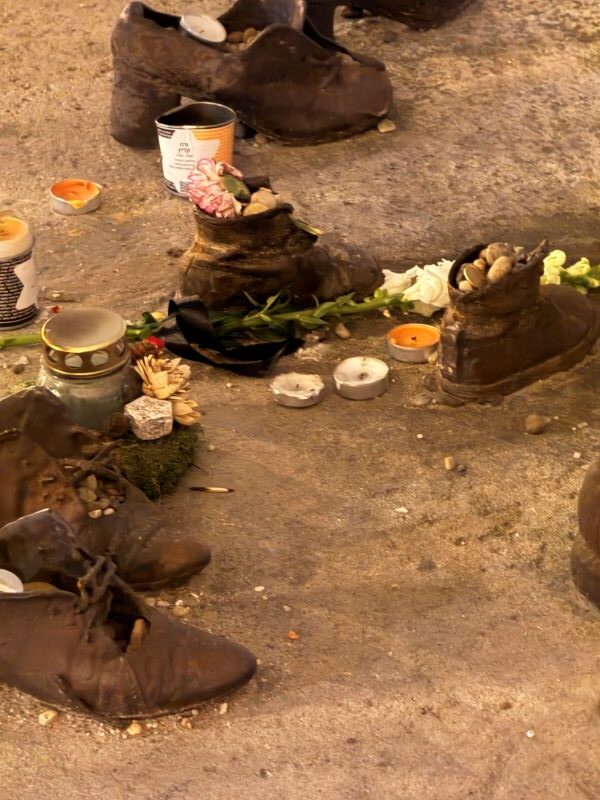
Conditions were horrific. Hunger, disease, and freezing temperatures claimed countless lives. Many others were taken from their homes and executed along the banks of the Danube River, their bodies thrown into the water. Today, the Shoes on the Danube Bank Memorial ( Cipők a Duna-parton) is a memorial erected on 16 April 2005, in Budapest, Hungary. Conceived by film director Can Togay, he created it on the east bank of the Danube River with sculptor Gyula Pauer [hu] to honor thousands of Jews massacred by the Arrow Cross Party in Budapest during the Second World War, winter 1944-1945. Victims were ordered to take off their shoes (shoes were valuable and could be stolen and resold by the militia after the massacre), and were shot at the edge of the water so that their bodies fell into the river and were carried away. The memorial represents their shoes left behind on the bank. 60 pairs sculpted out of iron – men, women, and children’s.
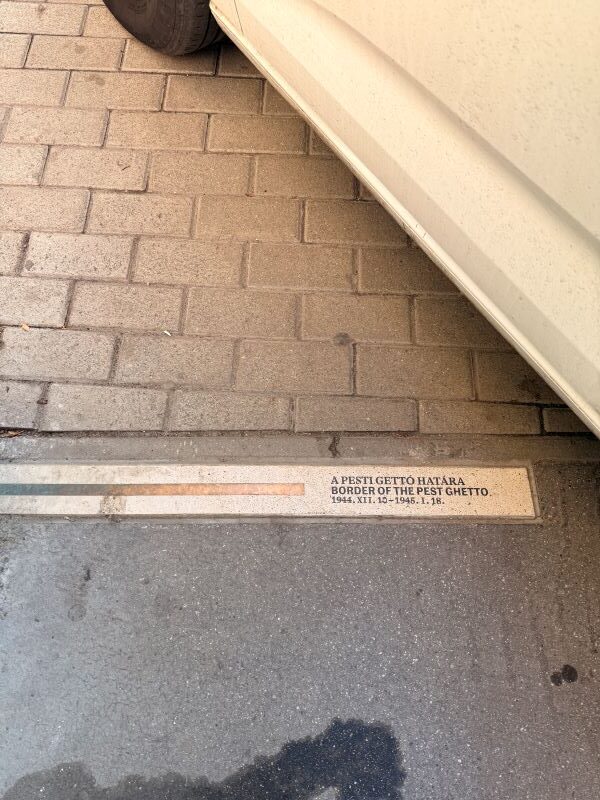
Walking through the Jewish Quarter, I followed subtle markers showing where the ghetto walls once stood. On Király Street, you can even see a small section of the wall reconstructed from original bricks. It’s an unassuming reminder that history can hide in plain sight.
The AR experience I tried, If These Streets Could Talk, superimposed digital visuals of the ghetto fence and soldiers onto the modern streetscape. Seeing that transformation, life layered over loss, stirred something profound. It wasn’t just learning about history; it was feeling it. The following three prototypes were the experiences I felt.
1. The Rescuer Perspective: “The Vanczák Family”
Disguised in an Arrow Cross uniform, you must risk your life to sneak into the Budapest ghetto and rescue the family members of a desperate shop owner.
You are Béla Vanczák (based on a true story)
The Story: Your family owns a shop on Csányi Street, right on the border of the ghetto. While you are free, 70,000 people are suffering just meters away. In this experience, you must wear an Arrow Cross uniform as a disguise and sneak into the ghetto to rescue the family members of a local shopkeeper, navigating dangerous checkpoints and risking your own safety to save others.
2. The Bystander Perspective: “The Gingerbread Cookie”
While escorting your grandmother on a holiday errand near the ghetto wall, a young Jewish boy’s plea for help forces you to choose between your personal comfort and moral responsibility.
You are a non-Jewish resident of the quarter
The Story: It is December 1944. You are walking freely on Király Street, escorting your grandmother to buy gingerbread for the holidays. The festive atmosphere contrasts sharply with the suffering behind the ghetto wall nearby. When a young Jewish boy approaches you asking for help, you are forced to make a choice: focus on your own life and errands, or step out of your comfort zone to help a stranger.
3. The Victim Perspective: “Two Loaves of Bread”
Trapped in the starving ghetto, you face a “choiceless choice”: deliver two smuggled loaves of bread to your friend’s dying mother, or save the starving children and elders begging you for help along the way.
You are a Jewish person trapped in the ghetto (At the end of this experience, I was crying. I will never forget the feeling I had of hearing the cries of hunger and turning away from them)
The Story: It is January 1945, and starvation in the Budapest ghetto is rampant. Friends have managed to smuggle two loaves of bread to you, which you promised to bring to a friend whose mother is dying. As you make your way through the streets, you encounter others in extreme need—an old man and a young boy—and face the agonizing moral dilemma of the “choiceless choice” imposed by an oppressive system: who do you save when you cannot save everyone?
Remembering and Rebuilding
When Soviet troops liberated Budapest in February 1945, over 100,000 Jews were still in the city, survivors of terror and starvation. In the decades since, Budapest’s Jewish community has rebuilt, reclaiming its identity and preserving its heritage. Today, the quarter is home to kosher restaurants, Jewish schools, cultural centers, and museums that keep those memories alive.
If you visit, make time for the Hungarian Jewish Museum and Archives, located next to the Dohány Synagogue, which holds artifacts, documents, and personal stories from Hungarian Jewish life before and after the war. For a quieter, more intimate reflection, step into one of the smaller synagogues like Rumbach Street Synagogue or Kazinczy Street Synagogue, both beautifully restored and still active today.
A Living Legacy
Budapest’s Jewish Quarter is not a relic, it’s a living neighborhood filled with resilience, creativity, and remembrance. It’s where history and modern life coexist, reminding visitors that empathy is the first step toward understanding. Whether you’re drawn by the history, the architecture, or simply the spirit of endurance that pulses through its narrow streets, this is one corner of Budapest that will stay with you long after you leave.
So when you walk through District VII, take your time. Look up at the architecture, look down at the memorials, and maybe, like me, let the past meet the present through the lens of AR. Because once you see what once stood here, you’ll never see Budapest, or humanity, quite the same way again.
Check out more about my Budapest trip by visiting RachelFerrucci on Instagram