Orange County’s fire code leaves almost no room for interpretation. When a building’s alarm system isn’t tied to a monitoring station, a fire can ignite and spread well before anyone dials 911. Picking the right provider for commercial fire alarm monitoring services in Orange County means looking beyond the price quote and verifying credentials, response times, and whether the company actually holds the licenses California demands.
Finding the right fire alarm monitoring in Orange County
Monitoring is the piece of a commercial fire alarm system where property managers most often underestimate their choices. A UL-listed central station – the facility that receives signals from your panel around the clock – isn’t automatically bundled into every contractor’s providing. Some companies install systems but farm monitoring out to a third party; others manage it internally under NFPA 72 compliance.
In Orange County, the Authority Having Jurisdiction (AHJ) typically demands documented proof that monitoring is active and that your contractor carries the correct state licenses. California’s State Fire Marshal licensing system – which includes separate E-series and A-series classifications – is what distinguishes contractors who can legally do this work from those who can’t. Check license numbers before signing anything; the CSLB database lets you verify them in about 90 seconds.
The five providers below cover a range of service scopes across Orange County and Southern California, from full-service multi-division contractors to regional specialists.
1. Spectrum Fire Protection
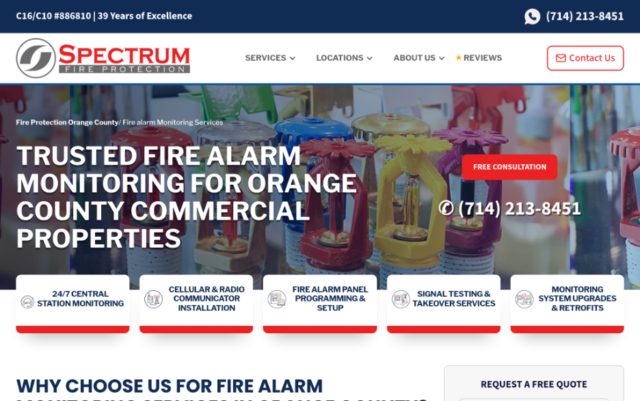
Spectrum Fire Protection is a family-owned commercial fire protection contractor based in Fullerton, covering all 34 Orange County cities with 24/7 service and a 2-hour emergency response target.
Where it fits: Spectrum added its fire alarm division in 2025, backed by a C-10 Electrical Contractor license alongside its long-standing C-16 (License #886810) and State Fire Marshal licenses E-2293 and A-0448. That licensing stack means one contractor can legally handle alarm installation, NFPA 72 inspection, and 24/7 UL-listed monitoring without farming work to subcontractors. For property managers running multi-site portfolios-hotels, retail centers, warehouses, medical offices – having six divisions (sprinklers, alarms, extinguishers, suppression, pumps, and hydrants) under one license simplifies compliance tracking considerably. The company carries a 5.0-star Google rating across 128 reviews and an A+ BBB accreditation since April 2019. Every deficiency is photographed and reported directly to the jurisdiction, so documentation is ready before the fire marshal arrives.
2. Fire Protection Tustin
Fire Protection Tustin operates under the Apex Fire Protection Services name and is based in Tustin, CA, serving surrounding areas across Southern California.
Where it fits: Apex covers the main fire protection categories (alarms, sprinklers, and extinguishers), positioning itself as a local option for businesses in Tustin and nearby Orange County communities. The company’s stated emphasis is on installations and routine inspections.
Worth checking: Detailed company background, team size, and founding year aren’t publicly available on the current website, which appears relatively new. Businesses with complex compliance documentation requirements may want to request verifiable credentials directly before committing.
3. Frakerfire
Fraker Fire Protection has operated across Los Angeles County, Ventura County, Orange County, and the Inland Empire for over 45 years, headquartered in Westlake Village at 725 Lakefield Rd Ste B.
Where it fits: The company’s service list runs wide: fire alarm systems, sprinklers, extinguishers, standpipe systems, fire door assemblies, elevator recall, and emergency lighting. Fraker also provides building code consulting through certified fire safety consultants – useful when a tenant improvement triggers a plan-check question. Technicians are licensed by the State Fire Marshal and/or the Contractors State License Board, and the company holds LAFD Reg 4 certification for fire safety equipment.
Worth checking: LinkedIn lists Fraker at 2 to 10 employees, which is worth clarifying if you’re a larger property manager expecting rapid service across multiple sites simultaneously.
4. Anchor Fire
The anchorfire.net site serves Los Angeles and Orange County, providing fire protection services for commercial and residential properties,es including sprinkler systems, pumps, and underground protection.
Where it fits: Local commercial accounts in the Orange County and LA area can reach Anchor for sprinkler and pump work. There’s a broader entity under the same name – the Pennsylvania-based Anchor Fire Protection, founded in 1978 with 51 to 200 employees and an ABC Eagle Award – but that operation is licensed in Pennsylvania, New Jersey, Maryland, Delaware, and North Carolina, not California. The California-facing site at anchorfire.net is the relevant entity for Orange County businesses.
Worth checking: Publicly available information on the California operation is limited. Licensing details, team size, and response time commitments aren’t visible on the site, so verifying California contractor credentials directly is a reasonable first step.
5. American Empire Fire Stop Inc
American Empire Fire Stop is based in Ontario, CA, with over 30 years in the construction industry, holding California license 1089652 and a Blue Book listing since 2022.
Where it fits: This company specializes in firestopping and fire protection specialties (UL-listed systems, code-approved fire-rated assemblies, joint sealants, acoustical caulking, and fireproofing for mechanical, electrical, plumbing, and structural penetrations). It serves all of California and typically engages clients from the planning stage of construction, including coordination meetings and inspections during the build. That makes it a better fit for general contractors and developers than for property managers looking for ongoing alarm monitoring.
Worth checking: American Empire’s focus is construction-phase firestopping rather than installed alarm systems or monitoring services. Companies needing NFPA 72-compliant monitoring for an existing building should confirm whether this scope is available before reaching out.
Types of commercial fire alarm systems and what they cost
The table below covers the main commercial fire alarm system types, their typical application, and published cost ranges as of October 2026. Pricing varies by building size, panel features, and whether monitoring is bundled.
| System Type | How It Works | Typical Application | Installed Cost Range | Monthly Monitoring |
| Conventional | Divides building into zones; identifies zone, not exact device | Small buildings, single-tenant retail | $1,500 to $6,000 | $25 to $60 |
| Addressable | Each device has a unique address; panel identifies exact location | Mid-size to large commercial, offices, warehouses | $6,000 to $30,000+ | $30 to $75 |
| Wireless | Devices communicate via radio frequency; no wire runs required | Retrofit projects, historic buildings | $4,000 to $20,000 | $35 to $80 |
| Hybrid | Combines wired and wireless devices on one panel | Buildings with mixed infrastructure | $5,000 to $25,000 | $30 to $75 |
| Voice Evacuation | Integrates alarm with paging/intercom for spoken instructions | High-rises, hotels, healthcare, schools | $15,000 to $80,000+ | $50 to $120 |
| Aspirating Smoke Detection (ASD) | Continuously samples air through pipes; catches smoke earlier than standard detectors | Data centers, clean rooms, server rooms | $10,000 to $50,000 | Not published separately |
Monitoring fees are typically billed monthly or annually and vary by the central station’s UL listing level, communication path (cellular, IP, or dual), and whether the contractor bundles monitoring with inspections. Annual NFPA 72 inspection costs – separate from installation – generally run $300 to $1,500 for a commercial system, depending on device count and panel type.
The system type a property requires is usually determined by local AHJ requirements, occupancy classification, and building square footage, not just budget. An addressable system in a 50,000-square-foot warehouse isn’t optional if code calls for it.
Bottom Line
Commercial fire alarm monitoring services in Orange County range from full-service contractors who cover installation, inspection, and monitoring under one license to specialists focused on a narrower slice of fire protection. The most critical filters are California contractor licensing (C-10 and C-16 where applicable, plus State Fire Marshal credentials), verified 24/7 monitoring through a UL-listed central station, and clear documentation practices that hold up when a fire marshal or insurer requests records. System type – conventional, addressable, voice evacuation – drives cost more than any other single variable, so getting a code-accurate scope of work before comparing quotes saves everyone time.