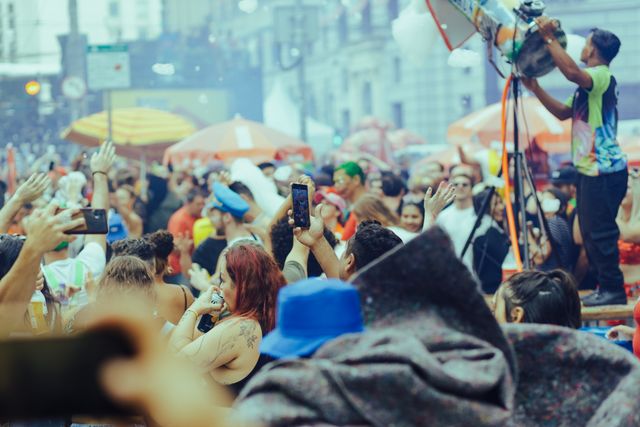
Festival crowds are loud, distracted, and flooded with competing visuals. If your brand doesn’t stand out in the first few seconds, it disappears into the noise.
The top 5 ways to improve brand visibility at festivals come down to strategy, scale, and knowing where attention actually lands. Each method below is practical, proven, and designed for the chaotic sensory environment that every major outdoor event creates.
1. Use Large-Scale Visual Displays
Brands that invest in custom inflatables for advertising campaigns get a format that physically dominates standard signage and draws foot traffic from across the venue. At a festival, where every competitor is fighting for the same eyeline, height and volume are your strongest assets. A display reaching 10 to 20 feet off the ground gets spotted from across crowded fairgrounds in a way a 6-foot banner simply can’t match.
Your display needs to pull double duty. It has to grab attention from a distance and still communicate your brand clearly to someone standing right in front of it. Bold color contrast, a minimal logo placement, and a shape tied to your product category all help accomplish that goal; avoid cluttering the display with too much text, because a visual that requires reading loses its punch at 50 yards. Think of it as a 3D billboard that earns attention before a single person walks up to your booth.
Large-scale displays also create natural photo opportunities, which means your branding travels beyond the festival footprint when attendees post on social media.
2. Claim the Right Physical Location
Your booth placement matters more than almost any other decision you make before the event. Brands that position themselves near high-traffic entry points, food areas, or main stages collect far more foot traffic than brands tucked into quieter corners of the grounds, no matter how good their setup looks.
It’s not just about volume; it’s about the right kind of traffic. If your product skews toward a specific demographic, find out which festival zones attract that crowd and request space accordingly. Most festival organizers release maps in advance, and early registration gives you a real shot at premium spots. Pay the premium if the location justifies it. The cost of better placement is almost always lower than the cost of a booth nobody finds.
Visibility from multiple angles is also worth thinking through. A corner spot or an island booth gets seen from two directions instead of one, which doubles your passive impressions without requiring additional spend.
3. Build an Interactive Experience at Your Footprint
Passive displays get attention, but interactive setups hold it. A booth where attendees can touch, try, taste, or participate in something creates a dwell time that a sign never will. That extended dwell time is where brand memory forms.
The interaction doesn’t need to be complicated. A spin-to-win wheel, a photo activation with branded props, a quick product demo, or a game tied to your brand category all work well in festival settings. The simpler the mechanics, the longer the line tends to get – and a line is itself a visibility signal. Other festivalgoers see a crowd and assume something worth seeing is happening.
Interactive setups also give your staff a natural reason to talk to attendees. That conversation is your most direct path to brand affinity, because it converts a stranger into someone who had an actual experience with your company rather than just a visual impression of it.
4. Run a Real-Time Social Media Campaign On-Site
A branded hashtag costs nothing and travels infinitely. Set one up before the festival, print it on every physical surface at your booth, and give attendees a clear reason to use it – a prize drawing for tagged posts, a photo contest, or a leaderboard displayed at your activation.
The mechanics matter, but so does the content you seed. Post from your own accounts throughout the day using the event hashtag and geo-tag the location; that gives the hashtag momentum before user-generated content picks up. When attendees see your brand actively posting from the same festival they’re attending, it builds a sense of shared experience that static advertising can’t replicate.
Don’t sleep on Stories and short-form video during the event. Behind-the-scenes clips from your booth setup, quick interviews with festivalgoers, and time-lapse footage of your activation all perform well organically. The goal is to make the festival feel like something your brand is genuinely part of, not just sponsoring from a safe distance.
5. Distribute Branded Merchandise That Gets Carried Around
Branded merchandise at festivals works as walking advertising. A well-designed tote bag, a useful lanyard, or a quality water bottle becomes a mobile impression every time someone carries it through the grounds. Your branding reaches areas of the festival you never physically occupy.
The selection is everything. Free merchandise that’s genuinely useful gets used. Cheap merchandise that feels like a throwaway ends up in a trash can by the end of the day. Think about what a festivalgoer actually needs in the next four hours – sun protection, hydration, storage, shade – and find the version of that item your brand can own.
Keep the branding clean and confident. A small logo on a high-quality item reads as more premium than a loud logo on a cheap one. Attendees who feel good about the item become unpaid brand ambassadors for the rest of the event, and that’s exactly the kind of organic reach that justifies the merchandise spend.
Strong brand visibility at festivals doesn’t happen by accident. It comes from deliberate choices about scale, placement, engagement, social amplification, and the physical items you put in people’s hands. The top 5 ways to improve brand visibility at festivals work best together: a towering visual display gets eyes on your booth, a great location delivers the right crowd, an interactive activation builds memory, a social campaign extends your reach, and smart merchandise keeps your brand visible long after someone walks away from your footprint.